A guide to Curling with Penicuik
The following information is available in booklet form for members.
This Info Pack
Seasoned members of Penicuik Curling Club are often asked questions by newer members who want to understand what goes on in the background of Curling within Penicuik and Curl Edinburgh(Murrayfield). This booklet hopefully contains information that might help give a better understanding to all.
Penicuik The Club
It all started in 1815. The history of our club is well documented within a book produced by club members to commemorate 200 years of Curling in Penicuik. There are also historical pages on our website http://www.penicuikcurlingclub.co.uk or simply search online, it’s surprising what comes up.
Who Operates Penicuik Curling Club?
The simple answer is, you do. We have an AGM at the end of each Curling season where the members appoint office bearers.
PRESIDENT is elected for a two-year term. Then becomes Immediate Past President and serves a further two years before standing down.
VICE PRESIDENT is usually nominated by the President and serves for two years.
SECRETARY serves a four-year term.
TREASURER serves a four-year term.
COMMITTEE MEMBERS (6 others) are in place for three years.
The Committee then appoints a Curling Sub Committee who take care of all matters to do with curling play during the season. There is a Social Committee put in place to arrange social events in and out of curling.
A Publicity Officer is also appointed.
Ordinary members can be drafted to help.
Further details can be found in our Constitution which is published and kept up to date in the Members’ Zone pages of our website.
How To Access Our Website
Just search for Penicuik Curling Club on your search engine to gain instant access to the website. Here you will find a welcome page, club news, results of all games, official documents such as our Constitution and AGM minutes as well as historical information. In addition, you can access contact details for members by using the access code which is available from the secretary.
The Games We Play
Within the club we operate various competitions during the season (October to March). All competitions are open to all members!
We start and end our season with a Bonspiel. This is a fun get together game to meet fellow members. There is also one held around Christmas.
Hurley Competition (named after a local pond) is the first competition of the season and is held in October. It has a league/knock-out format where teams play each other once. Winners of sections then enter play downs.
The Kettle is our main competition and runs throughout the season. It too has a League format where teams play each other twice.
The Thirds League is usually skipped by members who play 3rd in The Kettle.
Alternative club competitions are also organised for those who seek a different format. Knockout 4 player rinks play off against drawn opposition.
Points is a single session to test your skills in the various disciplines (Hitting, Drawing & Wicking).
Club Challenge allows any member to get a team together and challenge the current holders at any time in the season.
Pairs is always a well subscribed knockout competition.
Social Games against other clubs are regular fixtures in our calendar.
Saturday Development Sessions throughout the season allows members to learn and refresh their abilities.
Curl Edinburgh staff can also arrange Coaching sessions with trained coaches.
All games are listed in a Handbook which is distributed at the start of each season.
Trophies, prizes and medals are awarded at our end of season Prize Giving Dinner.
OTHER COMPETITIONS
Penicuik enter teams into competitions run by other organisations.
There are a variety of games offered, from fun Bonspiels to the Rink Championship to find the best in Scotland.
Lists of competitions can be found at Edinburgh Curling Club and the Scottish Curling (RCCC)websites. Any member can put their name forward to represent our club.
As most of Penicuik’s games are played at Murrayfield (Curl Edinburgh) a membership of Edinburgh Curling Club and Scottish Curling is a requirement.
Details of Ice and Membership fees can be found on the Penicuik website.
Administrative Arrangements
We try to car share when going to a game. The Skip will usually make transport arrangements and confirm that a full team(rink) is available.
If you are unable to attend any fixture, you should give your Skip as much notice as possible. In our club rules it is stated that a member should find a suitable substitute, but it often proves easier and avoids complication if the matter is dealt with by the Skip. Advice would be to sort an understanding at the start of the season.
Rules of Curling followed by Penicuik are those published by Scottish Curling with a few exceptions which are detailed in the Handbook.
Etiquette is always encouraged.
There is list of basics printed in the Handbook.
We are a sociable club and in the Curling Tradition would encourage members to socialise after a game, if only to be reminded about the great shots played. Custom dictates that the winners treat their opposition to a refreshment.
Fees for membership and games played are paid to our Treasurer.
The Treasurer will send out an invoice at the start of the season which is usually based on your playing intentions. A final invoice is issued at the end of season for any additional games played.
A subscription plan is offered. Members should contact the Treasurer for details.
Details of Ice and Membership fees can be found on the Penicuik club website.
The Roaring Game
The modern Curling game is quite different to that played in previous centuries. Gone are the days of owning and transporting your stones to a local pond in freezing conditions. However, Penicuik members often get the opportunity to enjoy outside ice. When conditions are right, members will “get the call”. It is when playing outdoor that the rumble and roar of stones going across the ice can be heard, the Roaring Game.
Today, the game is mostly played indoors and is more accurate and safer. There are rules to the game (too many to list here) but can be read at www.scottishcurling.org where you will find up to date Rules and Regulations.
Getting Started
If there are two club fixtures at the same time, the team listed first in the handbook will use the lower numbered sheet.
As a rule of thumb, a coin toss decides who curls first or second. Winner usually elects to play last stone.
Each player must release their stone before it crosses the ‘hog’. Foul throws are removed from play.
The aim is to slide your 20kg granite stones down the sheet to arrive in an area that is indicated by the Skip. There is quite a bit of strategy involved in the game and not all stones are wanted in the house (Marked Circles). For example, a Skip may wish their Lead’s stones to finish short of the house as they cannot be removed by the opposition until 5 stones have been played. Sweepers can influence the path of the stones (Rocks) by sweeping the ice ahead of the stone.
The speed, length travelled, and path of the stone can be altered with a good sweeping technique.
Two sweepers follow the stone down the ice and sweep when directed by the Skip who will call ‘Sweep’(Start) and ‘Up’(Stop)’to get the stone to the final resting place. Sweepers use a ‘Brush’ to sweep the stones. Today the term brush is still used but it is rare to see horsehair brushes in play as they can cause a stone to ‘pick-up’ if hairs become detached. The modern brush has a fibre glass shaft with a fabric pad.
Players who slide to deliver their stones wear curling shoes which have one smooth sole. The smooth Teflon shoe is covered with a rubber overshoe (Kipper or Gripper) when sweeping and walking. To avoid expense a Teflon overshoe may be an option for beginners.
Bespoke PCC clothing is available but any garments that gives free movement and warmth are acceptable. Head protection is recommended.
Stones are in place for play but players usually supply their own equipment such as Brushes, Stabilisers and Cues. Some Ice Rinks may hire these items.
Indoor Rules and Etiquette
There are four playing members in a team (Rink). Team positions are named as ‘lead’, ‘second’, ‘third’ and skip.
- Lead: Delivers (Throws) the first two stones. They will then help sweep the next six stones of the end. Lead usually has a strong drawing game. The lead in conjunction with their opposition toss a coin to gain the option of playing first or second.
- Second: Delivers the third and the fourth stones of that end. A second should be multi skilled and able to ‘draw’ and ‘takeout’. The second sweeps the first two stones and then again on the final four of the end. The second is usually tasked to keep a scorecard.
- Third: The third delivers the fifth and sixth stones of the end. They also have the responsibility of updating the scoreboard in agreement with the opposing third.
- Skip: The skip is the team captain. He/she will decide the strategy of the game. The skip might also discuss team tactics with the Third who should pass instruction to other team members. Skips normally deliver the final two stones of the end.
When the opposition are playing their stones, the rested sweepers should stand still on one of the hog lines.
GENERAL PLAY
- Each team has four players delivering two stones each. A player alternates their turn of play with their opposite number in the opposing team.
- Curling Stones: A rotation is applied on purpose when a stone is released. The stone curls (bends) in the direction asked by the skip. The faster the twirl the straighter the stone will travel.
- Sweeping: When curlers use their sweeping action, it often makes a stone go further down the rink and curve less. Sweeping will not add more speed to a stone. As a rule, sweeping a stone is the responsibility of the lead, second, and third. The skip rarely sweeps as they call the direction required.
- Keeping Score: Keeping the score in curling rules is quite easy because only one team scores per end. After all 16 stones come to rest in an end, the score is recorded. One point gets awarded for every stone that is closer than their opponents to the middle of the house. No points get scored at all unless a stone is inside the house or touching the outer ring.
- Games are normally played to 8 Ends OR the bell, whichever comes first. Once the bell is heard, the end in progress is played to a conclusion.

Curling Terms and Signage
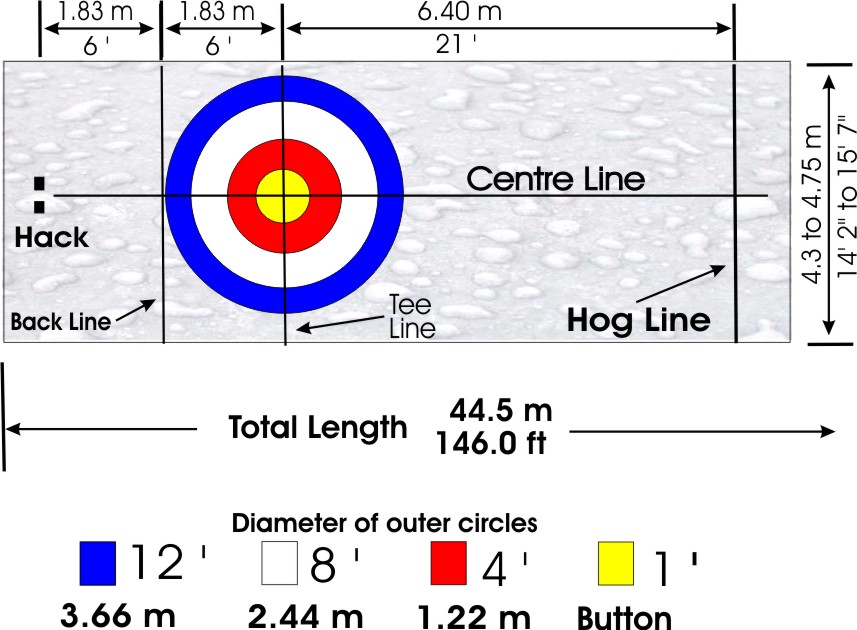
Above is a diagram of sizes and the signage that is found on the ice pad. From this signage, terms of description of the shot required by players have been adopted.
Skips will ask their players to play their stone to land in a certain area and may ask for
Barrier Weight This means that the delivered stone should reach the back surround of the ice pad. This weight is usually asked for to enable another stone to be removed from play.
Hack Weight The stone should stop at the hack at the opposite end of the sheet. This weight allows a slight draw (Curl) but still have enough momentum to remove or nudge another stone.
Back Rink Weight The stone played should stop at the back of the house(the coloured circles)
Tee Weight is asked for to come up to another stone but not take it out and finish on the tee line.
Button is the centre of the rings. Players can be asked to ‘Draw the Button’
4-foot, 8-foot, and 12-foot are the names given to the rings. Skips may ask for a stone to land on one of these rings in an area that has been indicated.
Hog There are two Hog Lines on a sheet. A stone must be released from a player before crossing the first line. It must then be clearly over the second hog line to avoid being removed from play. A Skip may point to an area between the House and the Hog Line. This is usually asked for to protect their stones from the opposition, (A Guard)
Skips will often give signs to other team members. They might ask for one of the weights described above but sometimes the noise in an ice hall can make voices hard to hear.
It is common for a Skip to point to the area that a stone is required to stop while backing that instruction with a hand sign.
If a Skip wants a stone to curl(draw) to a point, they are likely to pull their brush in the direction they expect the stone to follow. They might then tap the top of their brush at the point they would like the stone to stop.
If the Skip’s brush is held parallel to the body, this means that they want a Guard (a shorter stone) to avoid opposition getting near their shot (Counting) stone.
The weight of a stone required can also be shown by a hand sign. A Skip touching their ankle with their hand or brush indicates that your stone should stop at the hack. If a Skip requires a heavier stone to reach the Barrier, they might tap their shoulder or draw a hand across their stomach. The higher the hand goes, the heavier the stone required.
Direction of play is given by the Skip. A Skip holding their brush in their left hand and showing their right hand pointing to their right means they would like a stone to be delivered with the tail of the handle being sent to the left (Clockwise). A Skip showing a right hand means that the stone should travel anti clockwise.
Remember that the player and stone should be aimed at a Skip’s brush, not the Skip’s hand.
Calls and Terms That May be Heard
The list is endless as descriptions vary across Scotland and the World.
Burned =A stone is ‘burnt’ if it is touched in any way during play.
Cue =Also known as a Wand or Stick is used to aid stone delivery for players who do not slide from the hack.
Chap =Chap & lie, hit one stone out and leave the played stone closer to the button.
End =An end is a game within the whole game. We try to play 8 ends in a game.
Free Guard =Free guard zone is the area between the hog line and house where the ‘five rock rule’ comes into play. (See Curling Rules)
Freeze = Stop here (often against another stone)
Guard =Place a stone in front of a line that might protect counting stones.
Hack =The area from where players start their delivery.
Hammer =A team with The Hammer plays last stone. Often an advantage.
Heavy =Called by the player delivering a stone to alert team members it might not need swept.
House =The target circles
Hurry =Usually called by the Skip who thinks that a stone might be too slow to reach target.
In Turn =Send a stone clockwise. (anticlockwise for left handed delivery).
ICE!!! =A loud warning that there might be a stone heading your way. Stop the stone with your brush if it is a danger to others.
Ice =May be heard from the Skip while pointing meaning (take more ice)
Keen =Fast Ice (when a stone doesn’t need much weight is known as keen ice).
Light =Description of a stone that might not have enough power to reach target.
Out Turn =Send a stone anti clockwise. (clockwise for left handed delivery)
Pebble =Droplets of water that have been applied to the sheet of ice to aid better running of stones
Peeled =(Peels)Term given to a game where both teams have the same score.
Pickup =Debris on the ice alters the direction of a stone in motion.
Stabiliser = Also known as an Arrow or Rest is a piece of equipment that can be used to aid balance when delivering instead of a Brush.
Sweep! =The call given for sweepers to start sweeping.
Tight =Phrase meaning that a stone has been played to the inside of the skip’s brush.
Weight =Speed of the stone. “watch your weight” means don’t be heavy.
Wick =When a played stone comes off a resting stone to take a desired position.
Wide =Is an indication that a stone has been played outside the skip’s brush.
Delivery of a stone is often demonstrated by sliding out from the Hack before release. Stick (Cue)delivery is a common practice but again, the delivery must start from the Hack with an exception for wheelchair players.
Sweeping actions are usually performed by two members of the rink not involved in delivering a stone or directing play from the Head. Any or all members of a rink can sweep any of their team’s stones, but this is not recommended. Two players are the normal. Sweepers can both sweep on the same side, but they usually face each other. There are several methods used to sweep stones. Beginners are recommended to sweep in unison across the front of the stone.
If a stone is touched by a sweeper or their brush, it is removed from play as a ‘Burnt’ stone.
Stones can be swept anywhere from the hack to the tee line at the far end,
from there only one sweeper is allowed. The opposition Skip may only sweep the stone once it has crossed the tee line.
Be ready to play, don’t waste time!
While an opposition stone is travelling up the ice, a good player will be watching the track and weight of the opposition stone while cleaning their stone ready to play. Cleaning a stone before play helps prevent a ‘pick up’
To clean a stone, simply tip it on its side and wipe the running band with a glove or brush. Do not lift a stone!
Safety Although time on the ice is fairly safe, players should always be aware!
Always wear a Kipper when not delivering a stone. Replace worn Kippers.
Never run on the ice.
Never walk backwards, stones and other players are trip hazards.
Keep your brush under control by your side when not in use.
Do not stop travelling stones with your feet as you may be put off balance. Use your brush to stop or direct stones.
Always keep control of stones with your brush. Don’t kick them around.
Shout ICE! if your stone or any stone may be a danger to other players.
Cleanliness on the Ice Players should take steps to keep the playing surface clean to avoid pickups by stones.
Clean the inside of your Gripper (Kipper) before a game.
Clean your Brush before going on to the ice.
Check that your feet are clean before going on to the ice.
Clean your stone before play
Remove any debris from the ice.
Keep your fingers and hands and knees off the ice! Your body heat will melt the ice and cause bumps on the ice surface.
What’s In a Name?
It is not only new members that can be confused about various club names that are heard in Penicuik Curling circles. Some of the most common are.
Scottish Curling and R triple C are the same organisation. RCCC (Royal Caledonian Curling Club) was formed in the 1800’s to bring official rules and structure to the game. Penicuik Curling Club was one on the founding members.
Scottish Curling (RCCC) is the official body that guides Curling in Scotland. Membership allows you to play in games organised by them and gives a level of insurance required at Murrayfield and when on the ice. Subscriptions are paid via Penicuik, assuming that Penicuik is your Mother Club.
Murrayfield, Edinburgh Curling, Curl Edinburgh?
The ice pad that we play on was known as Murrayfield up until a few years ago. Signage outside now displays Curl Edinburgh.
Murrayfield Curling Ltd. (MCL), operate the ice facility in Edinburgh.
To play at Curl Edinburgh you must be a member of Edinburgh Curling Club(ECC). ECC are separate from MCL.
ECC is owned and operated on behalf of its members. Their purpose is to represent members, promote curling and organise competitions.
Subscriptions are paid via your Mother Club.
Mother Club is the Club that you elect as your home club.
RCCC & ECC fees are only paid once per year via your nominated Mother club.
You can join as many clubs as you wish without repeating these fees.
The Province, as it is known is the organisation that represents its local area. Penicuik is part of the Midlothian Province.
There is no separate fee.
WCF (World Curling Federation) is now known as World Curling. This is the world governing body in Curling.
For more information on the organisations that are named above, turn to your search engine.
Contacts
A full list of members’ contact details, as well as results, history, news and photographs are published on the Penicuik Curling Club website.
A list of members’ addresses, and phone numbers are printed in our handbook and are available to view on the website.
Penicuik Secretary penicuikcurlingsecretary@gmail.com or via their personal phone number for enquiries related to Penicuik Curling Club.
Curl Edinburgh info@curledinburgh.com 0131 337 4242
To book formal coaching or practice ice. Competition information and curling equipment sales.
For competition information, other club and member details, members offers.
Subscribe to their Four Bullet Friday for weekly curling news.
Enjoy Your Curling !
 Penicuik Curling Club